How New Patients Actually Choose You: The 8 Minutes Before They Call
When someone finally calls your office, it feels like the beginning of the relationship. It is not. It is closer to the end of a process that already happened without you, usually on a phone, usually at night, usually in under ten minutes.
We have watched enough of these journeys in the data to know the shape of it. A person decides they need to do something about a problem. They search. They land on a short list of two or three practices. They compare. They pick. Then they call the one that survived.
If your practice is not surviving that comparison, no amount of charm on the phone helps, because the phone never rings. So it is worth understanding what is actually happening in those eight minutes.
Minute one: the search that starts it
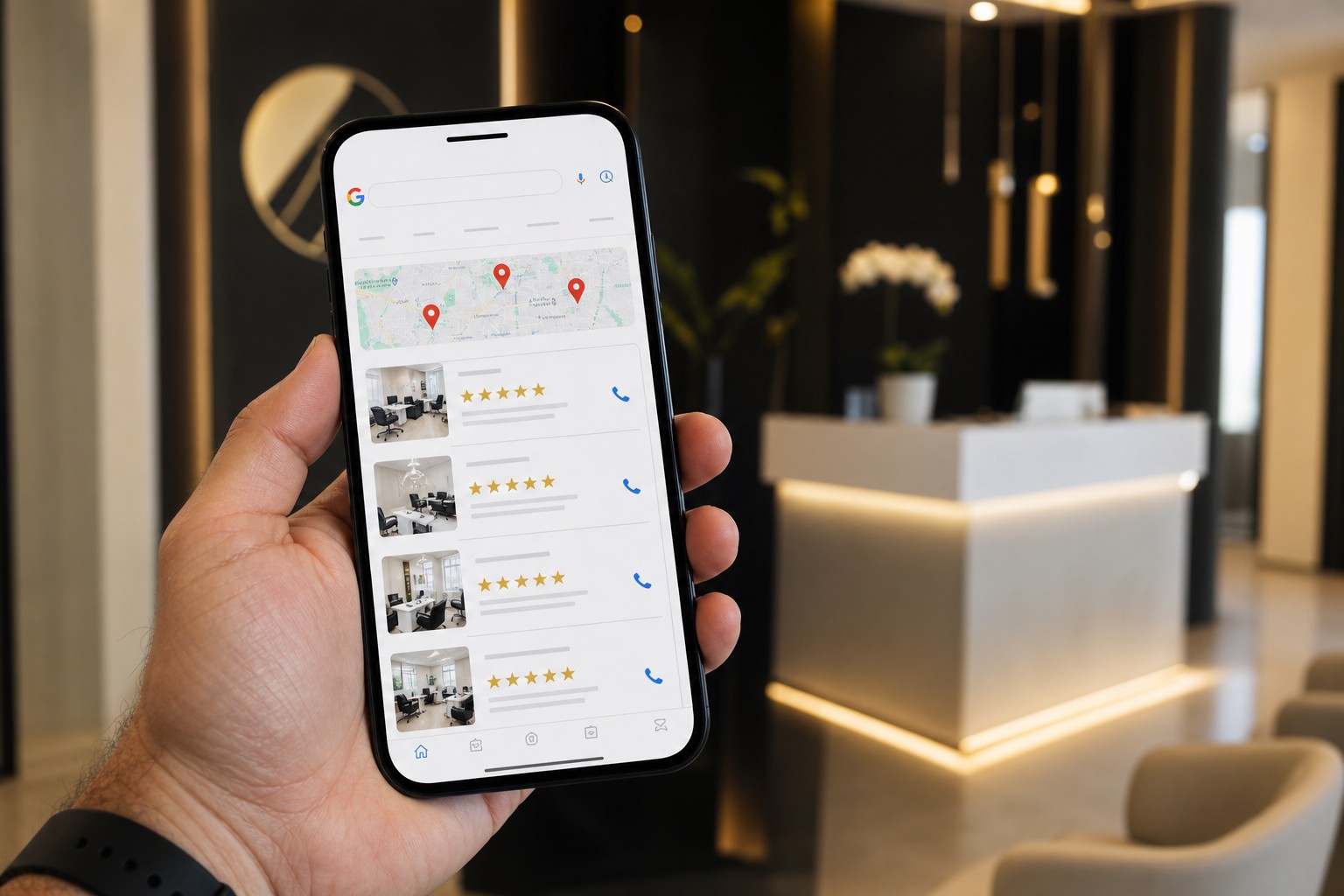
It almost never starts with your name. It starts with a problem or a place. Something is hurting, something broke, they moved to a new town, their kid needs to be seen. They type that into a search bar or, increasingly, ask an assistant on their phone to find them somewhere nearby.
What comes back is a small set of options with a rating next to each one. That is the first cut, and it is brutal. Most people never scroll past what fits on one screen. If your listing is incomplete, has old hours, or has no recent activity, you are quietly not in the running for the majority of local searches.
This is why we push clients so hard on the boring stuff. Correct hours. Correct services. Photos that were taken this year. It is not glamorous work and it decides who gets considered.
Minutes two and three: the reviews, read a specific way
People do not read reviews the way owners think they do. They are not tallying up an average and comparing decimals. They are looking for two things.
First, how recent are they. A practice with a hundred glowing reviews that stop eighteen months ago reads as a place that used to be good. Twenty reviews from the last three months reads as a place that is busy right now, and busy signals safe.
Second, what did the bad ones say and what did you say back. Nearly every prospective patient goes and reads the one and two star reviews on purpose. They are not looking for a perfect record, they know that does not exist. They are looking for whether the complaint is a dealbreaker for them personally, and whether the practice responded like an adult.
A calm, human owner response to a rough review does more for a nervous reader than five more five star ratings. It answers the question they are really asking, which is what happens to me if something goes wrong here.
Minutes four and five: your website, and one question
When they click through to your site, they arrive with a single question in mind, and it is rarely the one your homepage answers.
Your homepage usually says who you are and how long you have been in practice. Their question is some version of: can you handle my specific situation, and can I get in soon.
The pages that convert are the ones that answer the question directly. A page about the exact service they searched for. Plain language about what the first visit is like. Real availability, or at least a way to request a time without a phone call. And a way to actually contact you that is visible without scrolling or hunting.
The most common site problem we find at practices is not ugliness. It is that everything is there somewhere and nothing is where a stranger would look for it.
Minute six: the photos, and what they are really checking
People look at photos of a practice for a reason that has nothing to do with design. They are trying to see themselves in the room.
Stock photography actively hurts here, and patients spot it faster than you would guess. A generic smiling model in a generic operatory tells them nothing, and the moment someone realizes they are looking at a stock image, everything else on the page gets a little less credible.
What works is unremarkable and real. The actual front desk. The actual hallway. The actual team, including the people who are not the doctor, because those are the people a patient spends the most time with. If a nervous person can picture walking through the door before they call, the call gets much easier to make.
Minutes seven and eight: the human check
The final stretch is almost always about the people. They look up the doctor. They read the bio. They may look at a social profile or a video if you have one.
What they are doing here is checking whether you seem like someone who will listen. Credentials matter less than most practices believe at this stage, because the patient has no way to evaluate them. Tone matters enormously, because tone is the only thing they can evaluate.
A bio that reads like a CV gets skimmed. A short paragraph in normal words about how you approach a patient who is anxious, or how you explain options, does the work. If you have thirty seconds of video where you simply talk, that beats almost anything else on the page.
What this means for where you spend
Here is the practical takeaway. If your ads are generating clicks and your phone is quiet, the problem is somewhere in these eight minutes, and buying more clicks makes it worse, not better. You are paying to send more people into a comparison you are losing.
The fixes are cheap relative to ad spend. Get your listing complete and current. Build a steady, unforced habit of asking for reviews so the recent ones never dry up. Respond to the bad ones like a person. Replace the stock photos with your real space and real team. Make the first visit understandable to someone who has never been to you before.
Do that and the same ad budget produces more patients, because more of the people who see you make it through the eight minutes.
If you want an honest outside read on how your practice looks during that window, we walk owners through it regularly and we will tell you what we actually see. Call 585-802-1377 or start at brummble.com.


Comments