Stop Boosting Posts: Why Your Facebook 'Strategy' Is Burning Money
That Little Blue Button Is Costing You More Than You Think
Let me paint a picture. You post a photo of your team, your new product, your latest promotion. It gets a few likes. Then Facebook whispers in your ear: "This post is performing better than 80% of your recent posts. Boost it to reach more people." You think, sure, why not? Fifty bucks. A hundred. Let's see what happens.
Here's what happens: Facebook takes your money, shows your post to a bunch of people who will never become customers, and pats itself on the back for delivering "engagement." Meanwhile, you're wondering why your phone isn't ringing.
We see this constantly at Brummble. Local businesses here in Rochester and beyond, spending $300, $500, sometimes $1,000+ a month on boosted posts and genuinely believing they're "doing Facebook ads." They're not. They're feeding Meta's algorithm pocket change in exchange for vanity metrics. And it needs to stop.
If you've been boosting posts and calling it a strategy, don't feel bad — Meta designed it that way. But once you understand the difference between boosting and actual Facebook advertising, you'll never hit that blue button again.
What Boosting Actually Does (And Doesn't Do)
When you boost a post, you're using Meta's most stripped-down advertising tool. It's the training wheels version of Ads Manager — and Meta gives it to you on purpose because it's easy, it's fast, and it keeps you spending without asking hard questions.
Here's what a boosted post gives you:
Basic audience targeting (location, age, gender, a few interests)
One objective: engagement, video views, or messages (that's it)
No conversion tracking — you can't see if anyone actually called, booked, or bought
No A/B testing, no creative variations, no funnel strategy
Limited placement control — Meta decides where your ad shows up
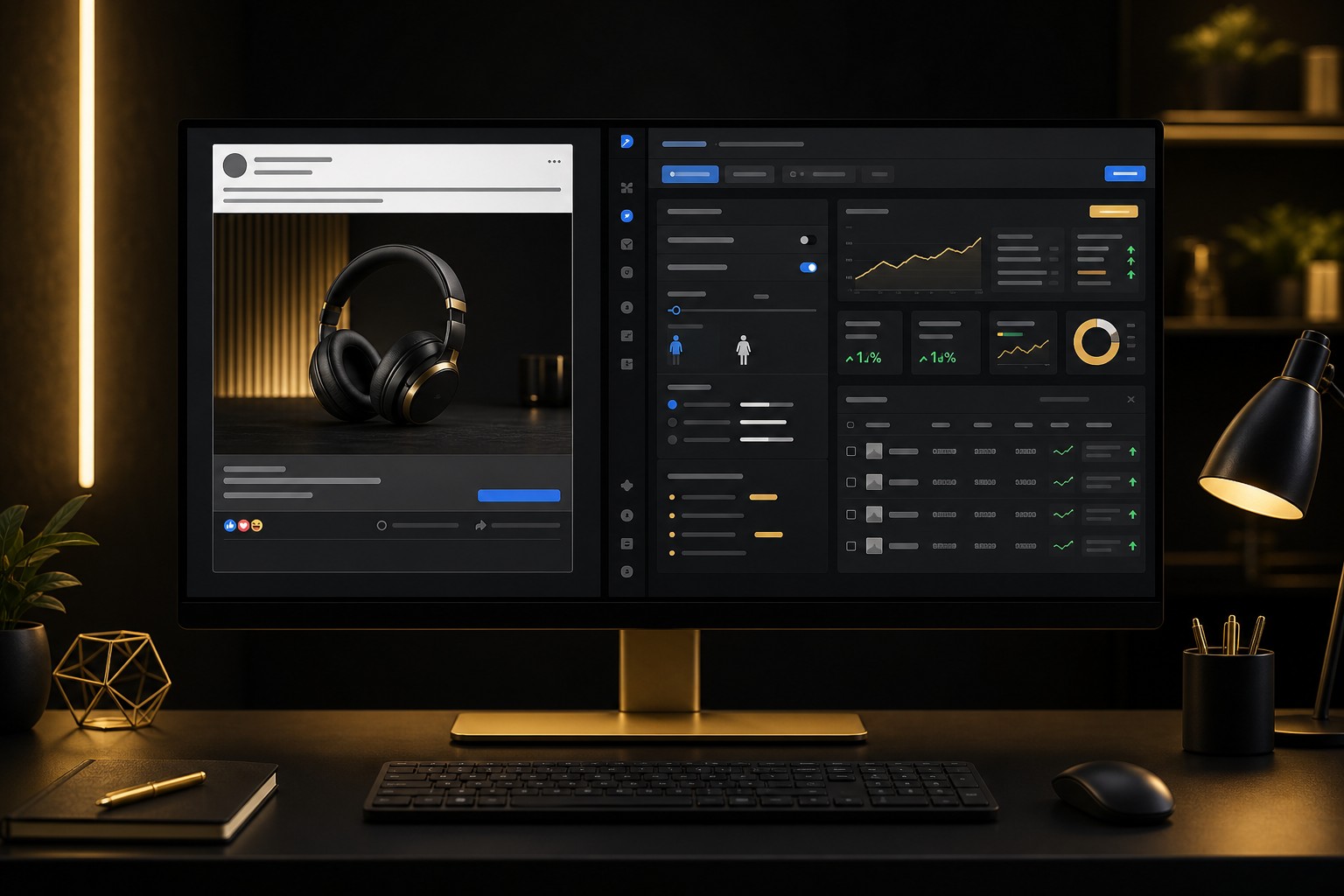
Compare that to what you get inside Ads Manager — the tool that actual advertisers use — and it's like comparing a Fisher-Price kitchen to a professional restaurant. Same general concept. Wildly different results.
Ads Manager gives you full control over objectives (traffic, leads, conversions, sales), detailed targeting and custom audiences, retargeting, lookalike audiences, conversion optimization, creative testing, placement strategy, budget optimization, and real attribution data. In other words: everything that actually moves the needle.
The Numbers Don't Lie: Boosted Posts vs. Real Ads
We've run this comparison enough times with enough clients to say it definitively: properly structured Facebook ad campaigns outperform boosted posts by 3-5x on every metric that actually matters.
We're not talking about likes. We're talking about leads. Phone calls. Form submissions. Actual revenue.
Here's what we typically see when a client switches from boosting posts to a real campaign structure:
Cost per lead drops 50-70% — because you're optimizing for conversions, not engagement
Lead quality improves dramatically — because you're targeting people likely to take action, not people likely to hit the thumbs-up button
ROAS jumps from unmeasurable to 4-8x — because you can actually track what happens after someone sees your ad
You get real data — what's working, what's not, and where to put the next dollar
One of our clients was spending about $500 a month boosting posts for over a year. They were getting likes and comments — plenty of them. Their "reach" numbers looked great on paper. But when we asked how many new customers came from those ads? Crickets. They had no idea, because boosted posts don't track conversions.
We rebuilt their strategy from scratch inside Ads Manager. Same budget. Within 60 days, they were generating 15-20 qualified leads per month at under $25 each. That's the difference between "doing social media" and doing social media marketing.
Why Meta Wants You to Keep Boosting
Here's the uncomfortable truth: Meta makes more money when you boost posts than when you run optimized campaigns. Think about it.
When you boost, you're spending money without any real optimization. You're not competing efficiently in the auction. You're not narrowing your audience to high-intent prospects. You're basically saying, "Here's some cash, show my thing to whoever." Meta loves that. Easy revenue, no heavy lifting.
When you run a real campaign with proper conversion optimization, Meta's algorithm has to work harder. It has to find the right people, optimize delivery, and prove results. But here's the kicker: even though Meta works harder, you spend less per result. Your dollars are more efficient. Which is great for you and slightly less great for Meta's quarterly earnings.
That "Boost Post" button isn't there because it's the best tool for your business. It's there because it's the easiest way for Meta to monetize small businesses who don't know any better. It's the digital equivalent of a casino putting the slot machines right by the front door.
"But My Boosted Post Got 500 Likes!"
Cool. How many of those people became customers?
This is the engagement trap, and it catches smart business owners every single day. Likes, comments, shares — they feel good. They look good in screenshots. Your cousin tells you, "Wow, that post blew up!" And you feel like your marketing is working.
But engagement and revenue are not the same thing. Not even close.
Meta optimizes for what you tell it to optimize for. When you boost a post for "engagement," the algorithm finds people who engage with stuff. These are chronic likers. Comment section regulars. People who scroll Facebook for entertainment, not to find a local business and spend money. They're great at clicking hearts. They're terrible at picking up the phone.
When you run a conversion campaign, the algorithm finds a completely different audience — people who actually do things. People who click, fill out forms, make calls, make purchases. Same platform, radically different targeting, radically different results.
What a Real Facebook Ad Strategy Looks Like
So what should you be doing instead? Here's the framework we use at Brummble for local businesses, and it works whether you're spending $500 a month or $5,000.
1. Start with a clear objective.
What do you actually want? Phone calls? Form submissions? Store visits? Online purchases? Pick one primary goal and build your campaign around it. "More visibility" is not a goal — it's a wish.
2. Build proper audiences.
Custom audiences from your customer list, website visitors, and social engagers. Lookalike audiences that mirror your best customers. Interest-based targeting layered with behavioral signals. This is targeting with a scalpel, not a sledgehammer.
3. Create ads that sell, not just posts that exist.
Your organic posts are for building community and staying top-of-mind. Your ads are for driving action. Different purpose, different creative, different copy. Stop repurposing organic content as ads and wondering why nobody clicks.
4. Install the pixel and set up conversion tracking.
If you can't track what happens after someone clicks your ad, you're flying blind. The Meta pixel (and Conversions API for bonus points) lets you see exactly which ads drive real business outcomes. Without this, you're just guessing — and guessing is expensive.
5. Test, learn, and optimize.
Run multiple creative variations. Test different headlines, images, and calls to action. Kill what doesn't work and double down on what does. This is how professional advertisers operate, and it's the reason they get 3-5x better results than the boost-and-pray crowd.
When Is Boosting Ever Okay?
Look, I'll be fair. There are exactly two scenarios where boosting a post isn't the worst idea:
First: you're a brand-new business and you literally just want some initial followers and social proof on your page. A few boosted posts at $5-10/day to build some early traction? Fine. But set a cap and move on.
Second: you have a genuinely viral organic post — something that's getting way more engagement than normal — and you want to amplify it for awareness. Not for leads. Not for sales. Just to get your name out there. That can work as part of a broader strategy.
In every other scenario — and I mean every other scenario — your money is better spent in Ads Manager with a proper campaign structure. Period.
The Bottom Line: You Deserve Better Than the Boost Button
Every dollar you spend boosting a post is a dollar that could've gone further, worked harder, and actually generated a measurable return inside a real campaign. You're not just leaving money on the table — you're actively setting it on fire and calling it marketing.
At Brummble, we manage Facebook and Instagram ad campaigns for local businesses across the Rochester area and beyond. We've seen firsthand what happens when businesses make the switch from boosting to real advertising — and it's almost always a game-changer. Lower costs, better leads, actual growth you can point to.
If you've been boosting posts and feeling like Facebook ads "don't work," I promise you: Facebook ads work. Boosting posts doesn't. There's a massive difference, and we'd love to show you what's on the other side.
Ready to stop burning money and start seeing real results? Give us a call at 585-802-1377 or visit brummble.com to learn how we can build a campaign strategy that actually moves the needle for your business.


Comments