The Complete Guide to Digital Marketing for Dental Practices (2026)
Updated: Jun 15
If you're a dentist or practice owner trying to figure out how to actually get more patients through the door — not just more likes on a post — this guide is for you.
We work with dental practices every day. We've seen what works, what wastes money, and what looks impressive in a report but never moves the needle. This is everything we'd tell you if we sat down for coffee.
Why Digital Marketing Matters More Than Ever for Dentists

Here's the reality: 77% of patients start their search for a new dentist online. Not with a referral from a friend. Not by driving past your office. They Google "dentist near me" or "best dentist in [city]" and they pick from what they see.
If you're not showing up — or you're showing up with a website from 2016 and no reviews — you're invisible to most of the people looking for exactly what you offer.
The good news? Most dental practices are still doing digital marketing poorly. That means there's a massive opportunity for practices that get it right.
The Five Pillars of Dental Practice Marketing
After working with dental practices across Western New York, we've found that effective marketing comes down to five things working together:
A website that converts visitors into appointments
Google Ads that capture patients actively searching
Social media that builds trust before the first visit
Local SEO that puts you on the map — literally
A retargeting strategy that follows up with people who didn't book
Let's break each one down.
Pillar 1: Your Website is Your Front Door
Your website isn't a brochure. It's a conversion tool. Every page should answer one question: "Why should I book an appointment here?"
What a high-converting dental website needs:
Mobile-first design (over 60% of your visitors are on their phones)
Page load time under 3 seconds
Clear calls to action on every page — "Book Now," "Call Us," "Request Appointment"
Real photos of your team, office, and patients (not stock photos of smiling models)
Reviews and testimonials front and center
Service pages for every procedure you want to be found for (not just one generic "Services" page)
The biggest mistake we see: practices spend $5,000-$10,000 on a beautiful website, then never update it. Your website needs fresh content, updated photos, and regular attention — just like your office does.
Pillar 2: Google Ads — the Fastest Way to Fill Your Chair
Google Ads puts your practice at the top of search results the moment someone types "dentist near me" or "teeth whitening [your city]."
Why it works for dentists:
You only pay when someone clicks
You target people who are actively looking for a dentist RIGHT NOW
You control your budget down to the dollar
Results are measurable — you know exactly how many calls and bookings came from ads
What a solid dental Google Ads strategy looks like:
Start with high-intent keywords. "Emergency dentist," "dentist accepting new patients," "dental implants near me" — these are people ready to book. Don't waste money on broad terms like "dental health tips."
Separate campaigns by service. Your general dentistry campaign needs different messaging than your cosmetic or implant campaign. The person searching "veneers cost" has different questions than the person searching "family dentist."
Use call tracking. If you can't trace a phone call back to an ad, you're flying blind. We set up call tracking for every client so we can tell you exactly which ad generated which call.
Set a realistic budget. For most dental practices, $1,000-$2,000/month in Google Ads is a strong starting point. That typically generates 30-80 new patient inquiries depending on your market and services.
Pillar 3: Social Media — Building Trust Before the First Visit
Social media for dentists isn't about going viral. It's about showing potential patients that you're real, you're good at what you do, and your office is a place they'd feel comfortable.
The content that actually works:
Before and after photos (with patient consent) — these get the most engagement, period
Short videos of your team in action — adjustments, cleanings, office tours
Patient testimonials — video is best, but even a screenshot of a Google review works
Educational content — "What to expect during a root canal" addresses fear before someone ever walks in
Behind-the-scenes — team lunches, birthday celebrations, office upgrades
What NOT to do:
Post generic stock photos with motivational quotes
Only post when you "have time" (inconsistency kills reach)
Ignore comments and messages (social media is a two-way street)
Boost posts without a strategy (we wrote a whole separate piece on why this wastes money)
The platform hierarchy for dentists: Facebook first (your patients are there), Instagram second (visual content shines), Google Business Profile posts third (helps local SEO). TikTok if you have someone on your team who genuinely wants to create video content — forced TikToks help nobody.
Pillar 4: Local SEO — Owning Your Map Presence
When someone searches "dentist near me," Google shows a map with three results before anything else. Being in that top three is worth more than any ad.
How to get there:
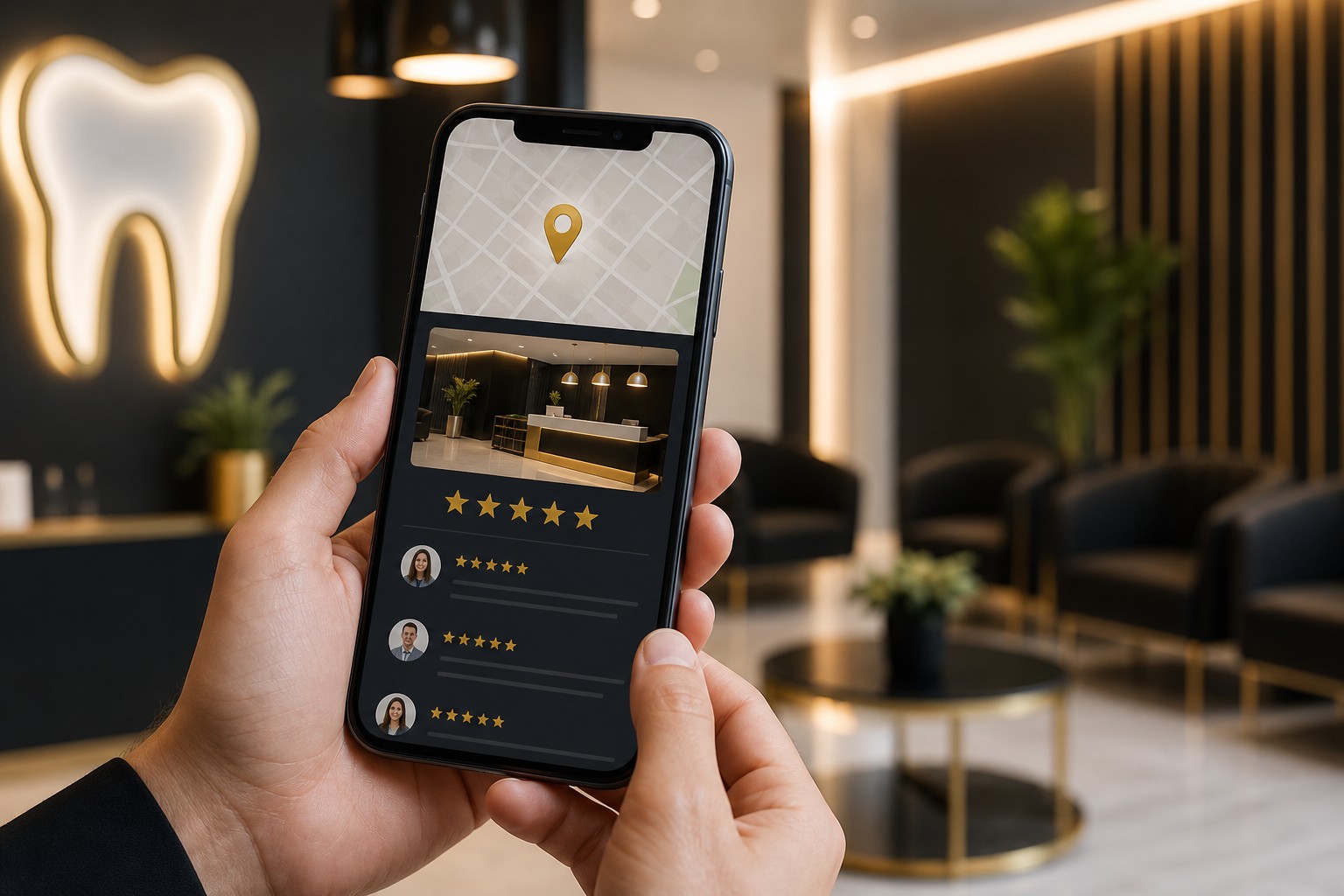
Optimize your Google Business Profile. This is free and it's the most underrated marketing tool for any local business. Complete every field. Add photos weekly. Post updates. Respond to every review.
Get more Google reviews. This is the #1 ranking factor for local search. Create a system — send a follow-up text or email after every appointment with a direct link to leave a review. Most patients are happy to help; they just need to be asked.
Build local citations. Make sure your practice name, address, and phone number are consistent across Yelp, Healthgrades, Zocdoc, your website, and every directory you're listed on. Inconsistencies confuse Google.
Create location-specific content. A page titled "Family Dentist in Brighton, NY" will rank better than a generic "Our Services" page. Create separate pages for each area you serve.
Pillar 5: Retargeting — the Follow-Up That Works While You Sleep
97% of people who visit your website don't book an appointment on their first visit. They're comparing options, checking reviews, getting distracted by their kids.
Retargeting shows your ads to those people after they leave your site — on Facebook, Instagram, and across the web. It's a gentle reminder: "Hey, you were looking for a dentist. We're still here."
Why retargeting works so well for dentists:
It targets people who already showed interest (warm audience)
It's cheap — typically $3-$8 per day is enough
It keeps your practice top-of-mind during the decision window
It works 24/7 without you lifting a finger
The key is using real photos and video from your practice — not generic ad graphics. Show the smiling team, the modern office, the happy patients. Make it feel familiar.
How Much Should a Dental Practice Spend on Marketing?
The honest answer: it depends on your goals and your market. But here's a general framework:
Just starting out / new practice: $2,000-$3,000/month (heavy Google Ads + website)
Established, looking to grow: $3,000-$5,000/month (Google Ads + social + SEO)
Aggressive growth / competitive market: $5,000-$10,000/month (full-service)
The most important thing isn't the number — it's that every dollar is tracked and accountable. You should know exactly how many new patients your marketing generated last month. If your current agency can't tell you that, there's a problem.
The Biggest Mistakes We See Dental Practices Make
Trying to do everything themselves. Your time is worth $500+/hour chairside. Spending 5 hours a week on social media posts is not a good use of your skills.
Hiring based on price. The cheapest marketing agency is almost always the most expensive in the long run. Ask for case studies, not just quotes.
Not tracking anything. "I think we're getting more calls" isn't data. Set up call tracking, form tracking, and review your numbers monthly.
Giving up too soon. SEO takes 3-6 months. Google Ads needs 60-90 days to optimize. Social media builds over time. If you quit after 30 days, you wasted your money.
Ignoring their online reputation. A 3.2-star Google rating will undo every marketing dollar you spend. Fix the reviews first.
What Working with a Marketing Partner Should Look Like
When you work with the right team, marketing shouldn't feel like another thing on your plate. Here's what we believe it should look like:
A strategy session where we learn YOUR practice — your strengths, your ideal patient, your goals
A clear plan with timelines and expected outcomes
Monthly reporting you can actually understand (no jargon, no vanity metrics)
Regular communication — not just a monthly email with a PDF
Content created from YOUR practice — real photos, real videos, real patient stories
Ready to Talk?
If you're a dental practice looking to grow — whether you're just starting digital marketing or you're frustrated with your current results — we'd love to hear from you.
No pressure, no long-term contracts. Just a conversation about what's possible for your practice.
Contact Brummble Digital Marketing: https://www.brummble.com
Call us: 585-802-1377


Comments